
Instant Guides
Grounding tools, journal prompts, and resources to support processing, reflection, and personal growth.
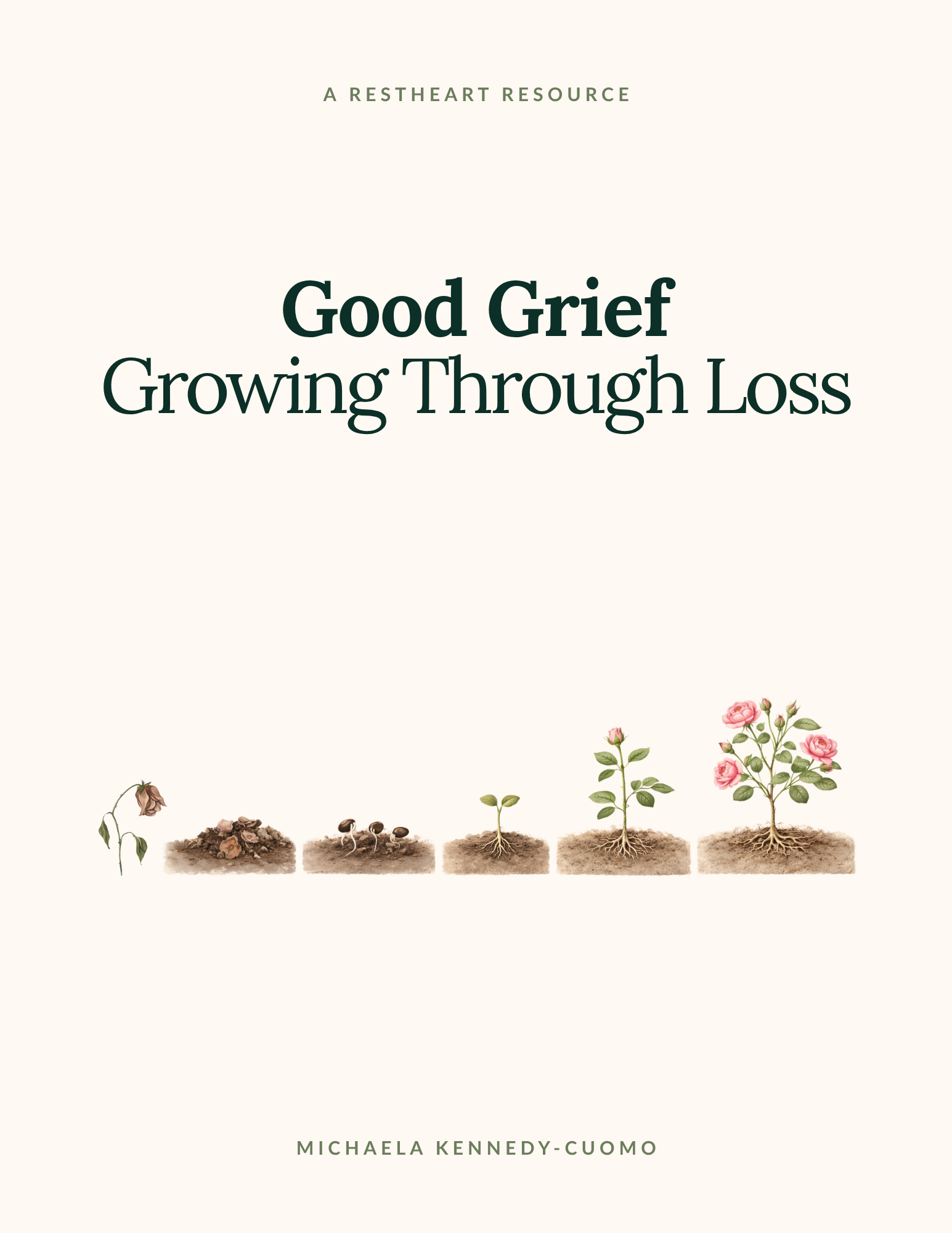
An 84-page digital guide to moving through any loss that left a mark.
Available as an instant download.
Most of us were never taught how to grieve.
We were taught to be strong, stay busy, move on.
And so the grief went somewhere — into the body, the nervous system, the sleepless nights and the sudden crying in the cereal aisle.
I learned this the hard way. Twice.
The first time, grief was a prison.
It held me in a fight/flight/freeze/fawn cage I couldn’t see or name.
The second time, it was a portal.
It taught me how to live fully and freely.
I created this guide from everything that actually changed me — nervous system science, somatic healing, and spiritual guidance — so it’s not as hard, dark, or lonely for you.
What's inside:
How grief moves through the body — and why it gets stuck
The stress cycle: what it is, what interrupts it, and how to complete it
A 4-step framework for moving through emotions without suppressing or spiraling
15+ practices for regulation, release, connection, and meaning-making
Journaling prompts, movement sequences, breathwork, visualization, and ritual
A non-linear structure — start anywhere, return as often as you need
Your body is not broken. It is responding exactly as it was designed to.
This guide explains why — and gives you the tools to work with it.
Take what helps. Leave what doesn't. Return whenever you need.
You are not alone.
$15
Most of us were never taught how to grieve.
We were taught to be strong, stay busy, move on.
And so the grief went somewhere — into the body, the nervous system, the sleepless nights and the sudden crying in the cereal aisle.
I learned this the hard way. Twice.
The first time, grief was a prison.
It held me in a fight/flight/freeze/fawn cage I couldn’t see or name.
The second time, it was a portal.
It taught me how to live fully and freely.
I created this guide from everything that actually changed me — nervous system science, somatic healing, and spiritual guidance — so it’s not as hard, dark, or lonely for you.
What's inside:
How grief moves through the body — and why it gets stuck
The stress cycle: what it is, what interrupts it, and how to complete it
A 4-step framework for moving through emotions without suppressing or spiraling
15+ practices for regulation, release, connection, and meaning-making
Journaling prompts, movement sequences, breathwork, visualization, and ritual
A non-linear structure — start anywhere, return as often as you need
Your body is not broken. It is responding exactly as it was designed to.
This guide explains why — and gives you the tools to work with it.
Take what helps.
Leave what doesn't.
Return whenever you need.
You are not alone.
An 84-page digital guide to moving through any loss that left a mark.
Available as an instant download.
Most of us were never taught how to grieve.
We were taught to be strong, stay busy, move on.
And so the grief went somewhere — into the body, the nervous system, the sleepless nights and the sudden crying in the cereal aisle.
I learned this the hard way. Twice.
The first time, grief was a prison.
It held me in a fight/flight/freeze/fawn cage I couldn’t see or name.
The second time, it was a portal.
It taught me how to live fully and freely.
I created this guide from everything that actually changed me — nervous system science, somatic healing, and spiritual guidance — so it’s not as hard, dark, or lonely for you.
What's inside:
How grief moves through the body — and why it gets stuck
The stress cycle: what it is, what interrupts it, and how to complete it
A 4-step framework for moving through emotions without suppressing or spiraling
15+ practices for regulation, release, connection, and meaning-making
Journaling prompts, movement sequences, breathwork, visualization, and ritual
A non-linear structure — start anywhere, return as often as you need
Your body is not broken. It is responding exactly as it was designed to.
This guide explains why — and gives you the tools to work with it.
Take what helps. Leave what doesn't. Return whenever you need.
You are not alone.
$15
An 84-page digital guide to moving through any loss that left a mark.
Available as an instant download.
Gentle mental health support for survivors of relationship abuse or sexual assault, including on campus.
Healing after sexual assault or abuse takes time, and it rarely moves in a straight line. This companion guide explains how these experiences can affect mental health, normalizes common trauma responses, and points you toward care that helps.
Inside, you'll find:
How abuse and sexual assault can affect mental health, and why healing is possible
Common responses to trauma, from sleep changes to trouble focusing at school or work
Who may face greater risk, framed around barriers, never blame
Ways to care for yourself, including trauma-informed therapy options
Crisis lines, mental health support, and campus resources, like counseling, confidential advocates, and Title IX
You don't need a diagnosis, and you don't need to have "moved on" to deserve care.
Created by Michaela Kennedy-Cuomo. A Restheart resource.
Healing after sexual assault or abuse takes time, and it rarely moves in a straight line. This companion guide explains how these experiences can affect mental health, normalizes common trauma responses, and points you toward care that helps.
Inside, you'll find:
How abuse and sexual assault can affect mental health, and why healing is possible
Common responses to trauma, from sleep changes to trouble focusing at school or work
Who may face greater risk, framed around barriers, never blame
Ways to care for yourself, including trauma-informed therapy options
Crisis lines, mental health support, and campus resources, like counseling, confidential advocates, and Title IX
You don't need a diagnosis, and you don't need to have "moved on" to deserve care.
Gentle mental health support for survivors of relationship abuse or sexual assault, including on campus.
Healing after sexual assault or abuse takes time, and it rarely moves in a straight line. This companion guide explains how these experiences can affect mental health, normalizes common trauma responses, and points you toward care that helps.
Inside, you'll find:
How abuse and sexual assault can affect mental health, and why healing is possible
Common responses to trauma, from sleep changes to trouble focusing at school or work
Who may face greater risk, framed around barriers, never blame
Ways to care for yourself, including trauma-informed therapy options
Crisis lines, mental health support, and campus resources, like counseling, confidential advocates, and Title IX
You don't need a diagnosis, and you don't need to have "moved on" to deserve care.
Created by Michaela Kennedy-Cuomo. A Restheart resource.
Gentle mental health support for survivors of relationship abuse or sexual assault, including on campus.
Available as a FREE instant download.
A private, judgment-free guide to recognizing abuse in any relationship, with gentle checklists and support resources.
Sometimes it's hard to name what's happening, especially when the good moments are real too. This 22-page guide offers clear, compassionate language for recognizing patterns of abuse in any close relationship: with a partner, date, family member, friend, roommate, or caregiver.
Inside, you'll find:
What abuse is, how it can grow over time, and how common it is
Reflective checklists across 11 forms of abuse, including emotional, financial, technology-facilitated, physical, and sexual abuse, stalking, reproductive coercion, and abuse that continues after a relationship ends
Gentle next steps, whenever you're ready
24/7 hotlines and specialized support resources
There's no scoring and no judgment. Go at your own pace, skip around, and stop whenever you need to. Whatever you find, abuse is never the fault of the person experiencing it.
Created by Michaela Kennedy-Cuomo. A Restheart resource.
Sometimes it's hard to name what's happening, especially when the good moments are real too. This 22-page guide offers clear, compassionate language for recognizing patterns of abuse in any close relationship: with a partner, date, family member, friend, roommate, or caregiver.
Inside, you'll find:
What abuse is, how it can grow over time, and how common it is
Reflective checklists across 11 forms of abuse, including emotional, financial, technology-facilitated, physical, and sexual abuse, stalking, reproductive coercion, and abuse that continues after a relationship ends
Gentle next steps, whenever you're ready
24/7 hotlines and specialized support resources
There's no scoring and no judgment. Go at your own pace, skip around, and stop whenever you need to.
Whatever you find, abuse is never the fault of the person experiencing it.
A private, judgment-free guide to recognizing abuse in any relationship, with gentle checklists and support resources.
Sometimes it's hard to name what's happening, especially when the good moments are real too. This 22-page guide offers clear, compassionate language for recognizing patterns of abuse in any close relationship: with a partner, date, family member, friend, roommate, or caregiver.
Inside, you'll find:
What abuse is, how it can grow over time, and how common it is
Reflective checklists across 11 forms of abuse, including emotional, financial, technology-facilitated, physical, and sexual abuse, stalking, reproductive coercion, and abuse that continues after a relationship ends
Gentle next steps, whenever you're ready
24/7 hotlines and specialized support resources
There's no scoring and no judgment. Go at your own pace, skip around, and stop whenever you need to. Whatever you find, abuse is never the fault of the person experiencing it.
Created by Michaela Kennedy-Cuomo. A Restheart resource.
A private, judgment-free guide to recognizing abuse in any relationship, with gentle checklists and support resources.
Available as a FREE instant download.